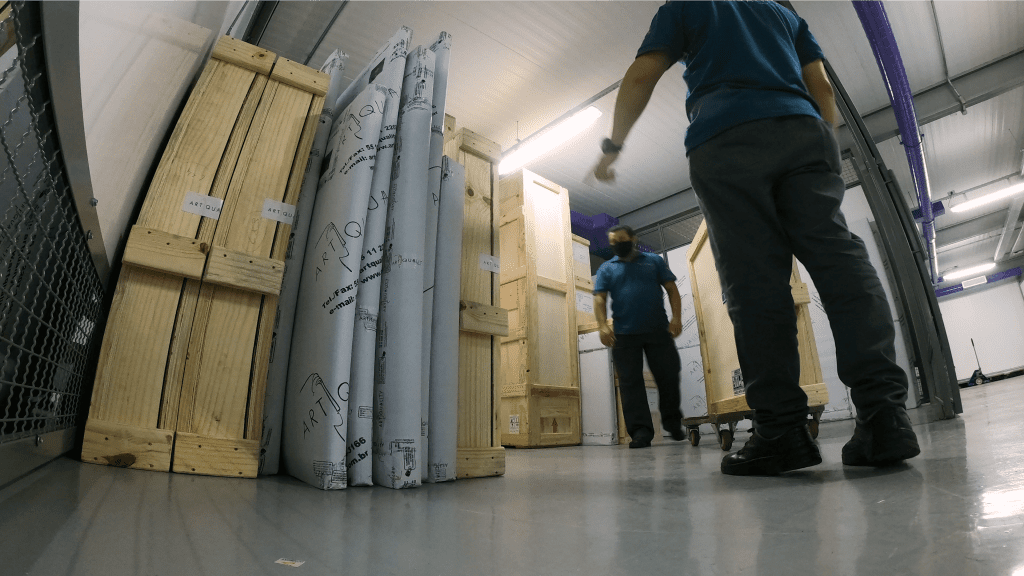
When a collection needs to leave its premises, be moved temporarily because of a renovation, wait for an exhibition or find medium to long term storage, choosing where to house the works is a decision that goes far beyond the availability of space.
For museums, cultural institutions, art galleries and collectors, hiring an off-site art storage facility for works of art means entrusting the physical integrity, security and preservation of irreplaceable property to a third party.
But how do you distinguish a structure genuinely specialized in collection care from a company that offers transport and warehousing as part of its services?
In Brazil, this distinction deserves special attention: it is essential to differentiate an art storage facility designed for the safekeeping of works of art from a conventional warehouse that also accepts this type of cargo.
1. Understand what off-site art storage is
An off-site art storage facility is a specialized space for the safekeeping and preservation of artworks, historical objects and other cultural property outside the premises of their owner or of the institution responsible for the collection.
Unlike a conventional warehouse, a specialized facility must take into account the needs of preventive conservation, environmental control, security, proper packing and the technical handling of each piece.
This service can meet different needs:
- Museums and cultural institutions: additional storage capacity, reorganization of collections, renovations and temporary storage when receiving loans for exhibitions.
- Art galleries: storage of works available for sale, management of large inventories and preparation for fairs and exhibitions, especially in another city.
- Private collectors: protection of collections, temporary storage (for example, during a renovation) and the organization of their holdings.
- Foundations and companies: preservation of corporate collections, historical holdings and works incorporated into the institutional heritage, as well as temporary storage when works need to be moved because of a change of premises.
The central point is that storing a work is not the same as preserving a collection. An art storage facility must be planned to meet the specific requirements of the objects it houses.
2. Check that the company actually operates an art storage facility
One of the first selection criteria is understanding the core business of the company you hire.
In the Brazilian market, there are carriers and warehousing companies that also transport works of art. That experience can matter when moving objects, but it does not mean, on its own, that their facilities were designed to function as art storage, or that the team is specialized in handling works of art.
A specialized art storage facility requires an infrastructure geared to collection care, with controlled environmental conditions, adequate security systems and specific procedures for the safekeeping of cultural property.
So before you sign, ask:
- Was the facility designed specifically for storing works of art?
- Is there continuous control of temperature and relative humidity?
- How are environmental deviations recorded and addressed?
- What are the security, fire prevention and fire response systems? Is there an on-site firefighter on duty 24/7?
- Does the team have experience handling and packing collections?
- Are there documented procedures for the entry, exit and movement of works?
- How is access to the storage areas controlled?
These questions help you assess the facility beyond its size, location or price.
3. Assess temperature and humidity control
Environmental stability is one of the most important factors in the preventive conservation of works of art.
Fluctuations in temperature and relative humidity can contribute to dimensional changes, warping, cracks, craquelure, corrosion and other deterioration processes, including the appearance of mold and pests.
The risks vary with the materials, the technique, the state of conservation and the history of each object.
An off-site art storage facility must have environmental parameters defined according to the needs of the collection, along with continuous monitoring and the ability to respond to deviations.
When evaluating a facility, find out:
- What temperature and relative humidity ranges are maintained in the space? Do they meet the international standard of a temperature between 18° and 22° and constant humidity between 45% and 55%?
- Is monitoring continuous, with verifiable records?
- Are there alarms and protocols for situations outside the established parameters?
- Does the infrastructure include contingency systems for power or equipment failures?
- What measures are in place against water infiltration?
It is not enough to ask whether the space is climate controlled. You need to understand how the climate control works, how it is monitored and what measures guarantee its continuity.
4. Examine the security and fire prevention systems
The security of an art storage facility involves much more than locks, cameras or guards.
A specialized structure must combine access control, monitoring, fire prevention, emergency protocols and procedures for moving and identifying works.
It is also important to check how the company handles the confidentiality of collections, especially when it serves private collectors, galleries and institutions dealing with works of high cultural or financial value.
Before closing the contract, make sure you understand:
- Who can access the storage areas?
- How are entries and exits recorded?
- What fire detection and prevention systems are installed?
- Are there contingency plans and teams prepared for emergencies?
- How is information about the works and their owners protected?
- What insurance coverage and responsibilities does the contract provide for?
Effective security depends on the integration of infrastructure, technology, people and procedures.
5. Consider the team's specialization and the handling of works
The conservation of a collection does not depend only on the environment where it is kept. Receiving, inventory, packing, movement and dispatch operations can also pose risks.
Two-dimensional works, sculptures, installations, archaeological objects and pieces made of sensitive materials call for different solutions.
A specialized company must assess the characteristics of each work and define appropriate procedures for its handling, identification and movement. When necessary, it should also offer support with preventive conservation, packing and logistics planning.
For museum and institutional professionals, it is worth checking whether the company can meet the collection's documentation and traceability requirements. For gallerists and collectors, it is important to know how pieces will be identified, located and made available when access is needed.
The goal is to ensure that the work receives consistent care throughout the storage period.
6. Assess the integration between art storage, transport and conservation
A work can be well protected while in storage and still face risks during transport to the facility, at collection or on the return to its place of origin. That is why it is important to evaluate how the company coordinates these stages.
In more complex operations, integrating specialized packing, transport, receiving, storage and dispatch can reduce communication failures and make it easier to track each work.
For museums and institutions, this integration can be especially useful during renovations, loans, traveling exhibitions and collection reorganizations. For galleries and collectors, it can simplify the logistics of sales, fairs, private presentations and frequent movements.
When requesting a proposal, make sure you understand exactly which services are included, which are outsourced and who takes responsibility for each stage.
7. Compare proposals on technical criteria, not just on price
Budget matters, but it should not be the only deciding factor when artistic and cultural heritage is at stake. Two companies can offer spaces of similar size at very different prices because their facilities, procedures and services are not equivalent.
For a consistent comparison, evaluate:
- Infrastructure designed for the storage of works of art.
- Environmental parameters and continuous monitoring.
- Security and fire prevention.
- Technical experience with collections.
- Storage options and space availability.
- Packing, transport and handling services.
- Inventory, access and traceability procedures.
- Insurance, contractual responsibilities and contingency plans.
- Flexibility to meet the collection's future needs.
An off-site art storage facility should be seen as part of the collection's conservation and management strategy, not merely as a real estate or logistics solution.
Clé Chenue do Brasil: specialized art storage and integrated care for art
For institutions and professionals looking for a specialized facility for the storage of works of art in Brazil, Clé Chenue do Brasil brings together climate-controlled art storage, conservation and fine art logistics under a single coordination.
With two facilities in Greater São Paulo and 7,500 m² dedicated to art, the company offers storage infrastructure kept at 18°C to 22°C and 45% to 55% relative humidity all year round, continuously monitored, along with security and fire prevention systems, including an on-site firefighter on duty 24 hours a day, seven days a week.
Available services include:
- Customizable spaces to suit each need: private or shared areas, including solutions for large format works. It is possible to store a single work or house entire collections.
- Specialized transport: national and international logistics for works and collections, internal moves, hoisting and exhibition support.
- Made-to-measure packing: solutions developed according to the characteristics of the work and the requirements of each journey.
- Conservation and restoration: services dedicated to the preservation and technical care of collections, through our partners.
- Collection management: cataloguing, appraisal, insurance, photography, framing and support with asset organization, through our partners.
Clé Chenue do Brasil combines the international tradition of the French firm André Chenue with the Brazilian experience of Expomus and specialized work in fine art logistics and storage. Its purpose is to integrate the different stages of caring for a work, from transport to conservation and storage.
To visit the facilities and assess the most suitable solution for your institution, gallery or private collection, contact our team.
Choosing an art storage facility means choosing how heritage will be protected today and preserved for the future.