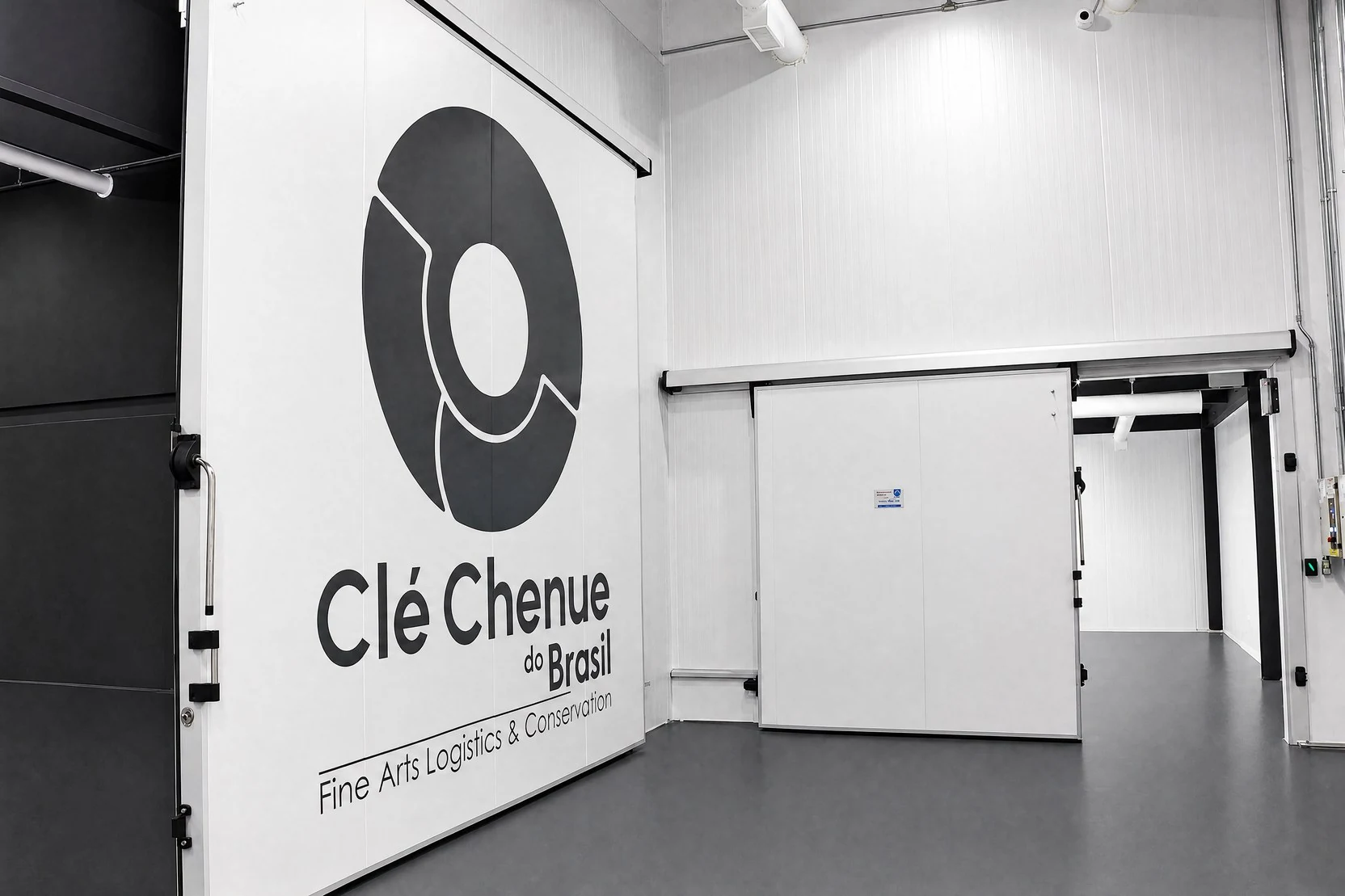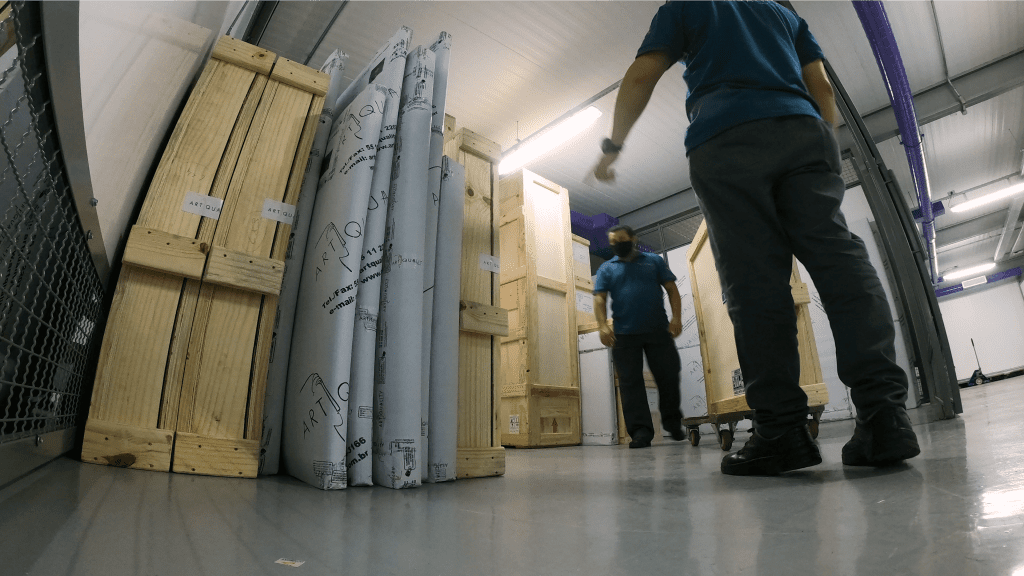
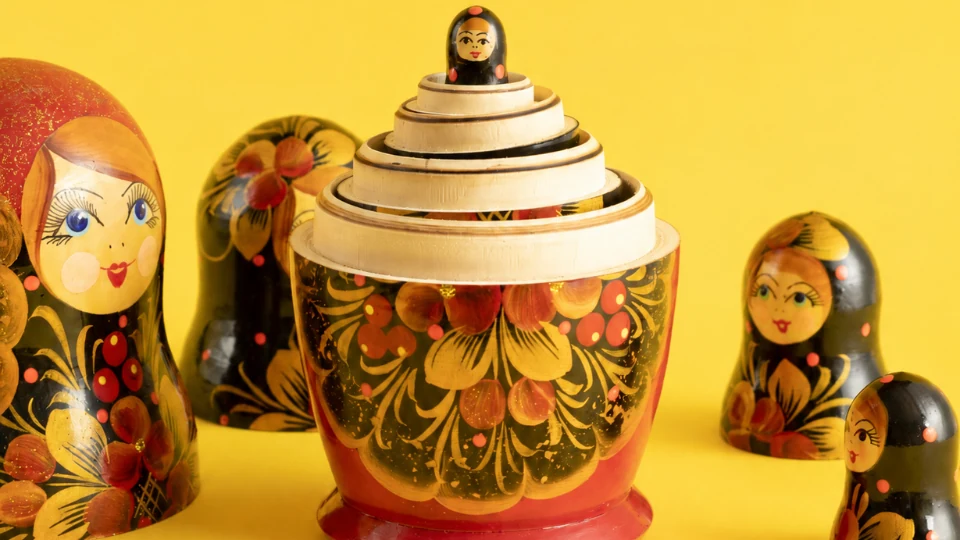
A storage space within a storage space. Like the traditional Russian dolls, which keep one piece inside another, a first-rate art storage facility can rely on several layers of protection. At Clé Chenue do Brasil, this logic translates into an infrastructure designed specifically to preserve works of art, with strict control of environmental conditions, permanent security and private spaces.
For those who have built a collection over years, often decades, preserving each work is as important as carefully choosing the next acquisition. And that preservation begins long before any conservation treatment: it begins with the place where the collection is kept.
What does a matryoshka have to do with art storage?
The matryoshka is one of the best-known objects of Russian culture. Originally, the hollow dolls are carved in wood and painted by hand, each slightly smaller than the other, forming a set that can be stored in layers.
The analogy helps explain one of the most important principles behind Clé Chenue's art storage: creating different levels of protection so that external conditions interfere as little as possible with the storage environment.
In practice, this means going beyond fitting a conventional warehouse with climate control and relative humidity equipment. It means designing a facility in which architecture, insulation, climate control, automation and security work in an integrated way.
One environment inside another: the secret of insulation
One of the structural solutions adopted by Clé Chenue is the construction of a building inside another building. The outer structure acts as a first protective barrier, while the inner environment is specially designed to maintain stable climate conditions. This configuration reduces the influence of the temperature and humidity variations that occur outside. If it rains or gets too hot, it is the outer building that takes that influence, while the inner chamber remains protected.
In addition, access runs through a system of antechambers and double doors. The inner door opens only once the outer one is already closed, which minimizes air exchange between the spaces and contributes to the stability of the internal climate.
The result is a space in which the works are not directly exposed to the climate swings that come with the seasons, sudden changes in temperature or periods of heavy rain.
This precaution is especially relevant because environmental stability is among the most important factors in the long-term conservation of a collection. Variations in temperature and, above all, in relative humidity can cause physical and chemical changes in different materials, affecting canvases, paper, wood, metals, photographs and other supports, as well as encouraging the appearance of mold and pests.
Temperature and humidity under permanent control
At both Clé Chenue do Brasil facilities, climate control maintains strict conservation parameters, with a temperature of 20 °C ± 2 °C and relative humidity of 50% ± 5%, monitored continuously, 24 hours a day.
More than reaching certain numbers, the challenge is keeping them stable. That is why the infrastructure relies on automation systems and equipment sized to run continuously.
Protection also takes exceptional situations into account. Each facility has its own generators, with an installed capacity of 340 kVA split between two units, ensuring the continuity of climate control and environmental management systems even during power outages.
This redundancy is a fundamental part of a facility designed so that the safety of the collection does not depend on external conditions.
Security: a combination of technology, architecture and human presence
An art collection brings together not only objects of great economic value but also pieces of historical, cultural and sentimental importance. Protecting it therefore requires an approach that addresses different risks.
At Clé Chenue, security combines technology, physical barriers and specialized teams. The system includes RFID access control, high-resolution CCTV, an armored guardhouse, a monitored perimeter and armed guards around the clock.
Fire prevention receives equally rigorous attention. The facilities feature areas compartmentalized by fire-rated walls and doors, smoke detection systems connected to the fire department and a firefighter on site 24 hours a day, seven days a week. Emergency plans, training and periodic drills complete the structure.
Each layer has a specific function. Together, they form an integrated protection system in which prevention is as important as the capacity to respond.
A third layer: the privacy of each collection
At Clé Chenue's art storage facility, protection can gain yet another dimension: privacy.
In addition to shared spaces, the company offers private rooms starting at 25 m², with layout and furnishing options suited to the characteristics and needs of each collection. The spaces can reach 600 m², serving everyone from collectors with a select group of works to large private and institutional collections.
This option gives clients an exclusive space for their collection, with access control and storage conditions integrated into the facility's security and climate control infrastructure.
Another distinctive feature is remote monitoring via IoT technology. Clients can use their phones to track the
For large works, the facilities also offer six-meter ceilings, expanding the possibilities for storage and placement.
7,500 m² dedicated to preserving art
Clé Chenue operates two art storage facilities in Greater São Paulo, totaling 7,500 m² dedicated to storing artworks and collections. Both follow the same demanding standard of climate control, security and monitoring.
This structure makes it possible to meet very different needs: from storing a single work to preserving entire collections, with private or shared solutions.
The company's expertise also goes beyond storage. Preventive conservation, restoration, packing, cataloguing, photography, framing, appraisal and collection management can be built into the service through specialized teams and partners.
It is an approach that considers the work across its full trajectory: from its arrival in storage to eventual transport, exhibition, loan or return to the collection.
Excellence is not a detail. It is the principle behind every choice.
Preserving a collection requires specialized knowledge, suitable infrastructure and permanent attention. Offering storage space is not enough: it takes understanding the particularities of each work, anticipating risks and establishing conditions that favor its conservation over time.
This is the vision that guides Clé Chenue do Brasil. The combination of the international tradition of the French company Chenue, whose history began in 1760, and the Brazilian museological expertise of Expomus, founded in 1981, brings together experience, technical knowledge and international standards of excellence.
For collectors, families, galleries and institutions that understand the value of their heritage, choosing an art storage facility is a strategic decision. It means entrusting to others not only the safekeeping of objects but also the responsibility of preserving stories, memories and works that span generations.
At Clé Chenue, every layer of protection has a purpose: to ensure that what deserves to be preserved today continues to exist tomorrow. Get to know the art storage facilities of Clé Chenue do Brasil and discover the storage, conservation and security solutions developed for special collections.
Schedule a visit to our facilities.